DAR Global.
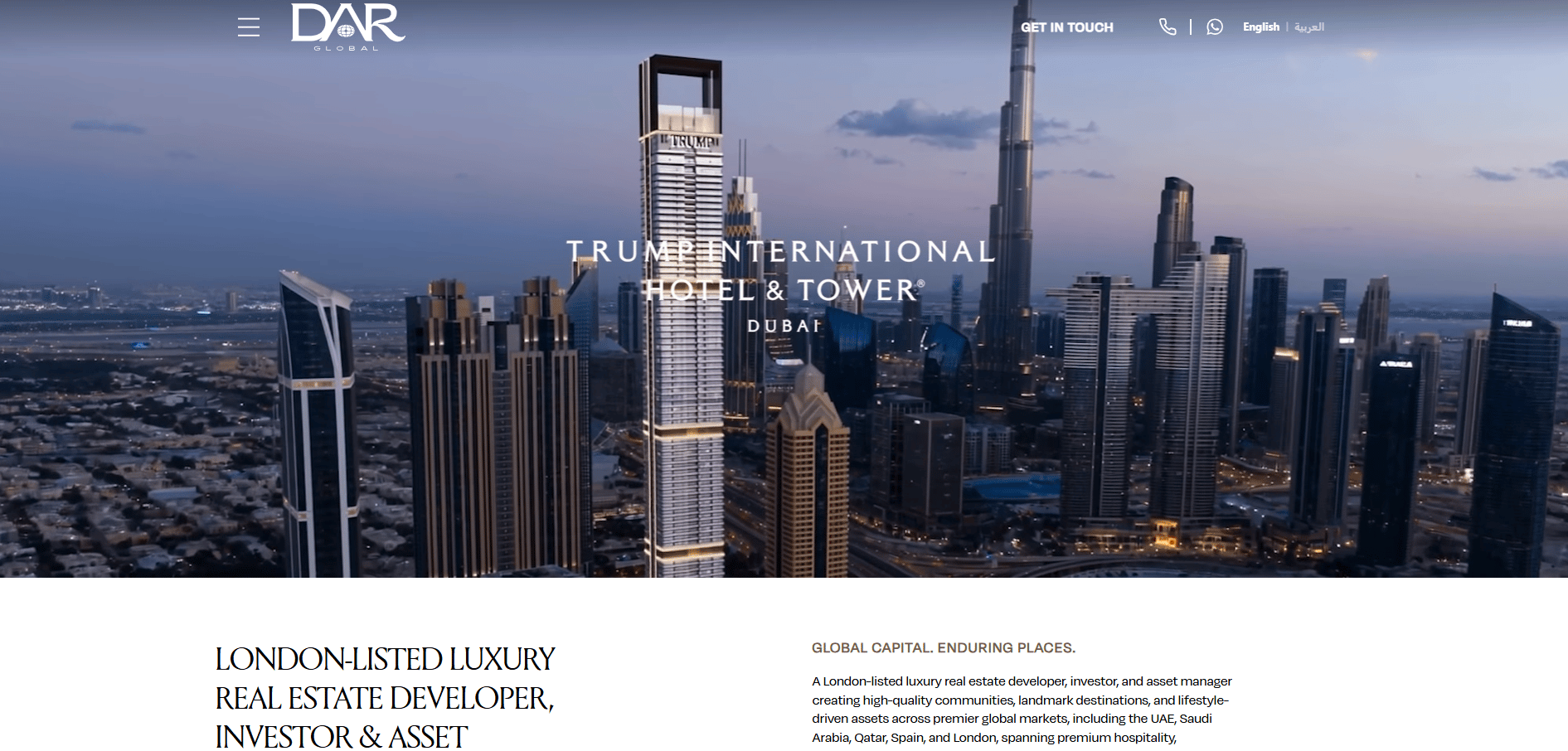
A multilingual, content-driven property website built around a modern frontend experience and a Strapi-powered content platform.
Context
A property brand needed a website that could carry premium visual storytelling while staying genuinely editable by the people who run it day to day.
The site is multilingual and content-driven: almost everything on a page — copy, media, listings, navigation — is authored in Strapi and rendered through a Next.js frontend.
My role
- Frontend development across the marketing and listing experience
- Integrating Strapi content models into Next.js pages and components
- Forms, search and navigation behaviour
- Analytics and UTM handling
- Responsive implementation from small phones to wide desktop
The Problem
Create a modern property experience while working with dynamic CMS content, forms, APIs and changing business requirements.
The hard part was not any single feature. It was that the content shape, the language variants and the commercial priorities all kept moving while the frontend still had to feel considered and stable.
The Approach
Break the experience into reusable components, keep content manageable through Strapi, and make the frontend responsive and scalable.
Rather than building pages, I built a vocabulary of sections that content editors could compose. That way a new campaign page became a content task instead of a development ticket.
The Build
A Next.js frontend consuming REST APIs from a Strapi content platform, deployed on AWS.
- Next.js
- Strapi
- AWS
- REST APIs
- Responsive UI
The Challenge
Balancing client expectations, technical limitations, content requirements and frontend polish.
Multilingual content in particular has a way of breaking layouts that looked perfect in one language. A lot of the work was making components tolerant of content they were never designed around.
Project technology
What I built
Composable content sections
Page layouts are assembled from a fixed set of section components, each mapped to a Strapi component. Editors compose pages; the frontend guarantees they still look right.
Search and navigation
Listing discovery and site navigation were built to stay responsive as the content set grew, with state that survives navigation and deep links.
Forms and lead capture
Enquiry forms with validation, error states and submission handling — wired to the APIs the business already used.
Analytics and UTM handling
Campaign parameters are captured, preserved through the user's session and attached to submissions so marketing attribution stays intact.
Outcome
A maintainable frontend experience designed around real content and real business workflows.
New pages and campaigns can be produced from the CMS without a frontend release, and the component set gives the brand a consistent visual language to build on.
Key takeaways
- Designing components around the content model — not the mockup — is what makes a CMS-driven site survive its second year.
- Multilingual is a layout constraint long before it is a translation task.
- The most useful thing you can give a client team is the ability to change their own site safely.